Bucket Jans And Bottles Cap Twisting Machine Automatic 4 Wheel Screw Capping Machine With Cap Feeder Elevator
CM140 4-Wheel Spindle Capping Technology — The Engineering of Continuous-Motion Cap Tightening
The Spindle Capping Principle
Spindle capping — also called rotary wheel capping or four-wheel capping — is a fundamentally different approach to bottle closure than the single-head vertical capping used by servo and pneumatic cappers. Instead of a single capping head that descends onto each bottle, tightens the cap, and retracts, a spindle capper uses multiple rotating wheels arranged around the bottle path. Bottles flow continuously through the wheel array, and each wheel contributes a specific tightening action as the bottle passes.
This continuous-motion principle delivers three key advantages:
- Higher throughput — no per-bottle stop-and-cycle time
- Mechanical simplicity — no vertical motion axis, fewer precision components
- Gentle cap handling — symmetric force distribution, no concentrated pressure points
The CM140's implementation of spindle capping uses four wheels, each with a defined role in the tightening sequence.
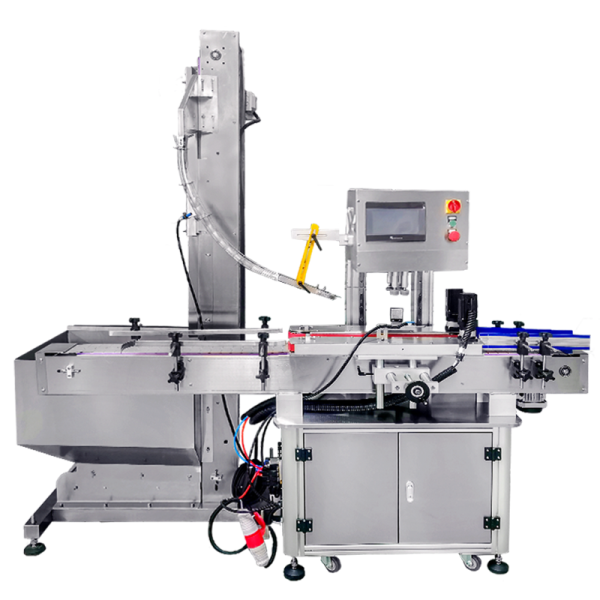

Wheel-by-Wheel: The Four-Stage Tightening Sequence
As the bottle enters the capping zone carrying a loosely placed cap, Contacts the cap and rotates it in the REVERSE direction (counter-clockwise for standard right-hand thread caps). This reverse rotation causes the cap thread to "click" past the bottle thread, confirming that the threads are not crossed. When the thread start points align, the cap drops slightly — a tactile confirmation of correct thread engagement.
This reverse pre-spin is the CM140's secret weapon against cross-threading. In single-head cappers, the head simply descends and rotates in the tightening direction — if the threads happen to be misaligned at the point of contact, the cap cross-threads before the error is detected. The CM140's reverse pre-spin ensures that by the time forward tightening begins, the threads are already in correct alignment.
Center Compression Device — Cap Seating
Function: Apply consistent downward force during tightening
Positioned above the bottle path at the center of the wheel array, the center compression device is a spring-loaded pad that presses down on the top of the cap as it travels through the capping zone. This downward force:
- Ensures the cap remains fully seated on the bottle neck — the cap cannot "ride up" during tightening
- For trigger sprayers and pump dispensers: guides the dip tube into the bottle during tightening
- For child-resistant caps: provides the "push" component of the push-and-turn motion
- For caps with foam or foil liners: compresses the liner against the bottle rim for a proper seal
The compression force is adjustable via the spring tension — lighter for delicate glass bottles, firmer for heavy-duty industrial caps.
Silicone Wheels: Why Material Matters
The CM140's capping wheels are fabricated from high-purity silicone rubber — a deliberate material choice with specific advantages:
- High friction coefficient: Silicone grips caps securely without requiring excessive contact pressure
- Surface-safe: Does not mar, scuff, or mark cap surfaces — critical for decorative and premium closures
- Chemical resistance: Unaffected by common product residues, cleaning agents, and mild chemical exposure
- Temperature tolerance: Maintains grip characteristics across the temperature range encountered in normal packaging operations
- Durability: Silicone wheels typically last 1-2 years in single-shift operation before replacement is needed
For applications requiring different friction characteristics (unusually slippery cap materials, oily environments, or high-temperature operation), alternative wheel materials are available.
Spindle Capping vs. Single-Head Servo Capping
| Parameter | CM140 4-Wheel Spindle | Single-Head Servo (e.g., CM100) |
|---|
| Capping mechanism | Four rotating wheels, continuous motion | One servo-driven head, per-bottle cycle |
| Throughput | Up to 45 bottles/min | 25-45 bottles/min |
| Torque control | Mechanical clutch (adjustable, consistent) | Servo motor (digital, programmable) |
| Torque data logging | Not available (mechanical) | Available (digital, per bottle) |
| Trigger sprayer handling | Excellent (custom track + compression) | Good (programmable motion profile) |
| Changeover | Mechanical adjustments, 10-20 minutes | Recipe recall + mechanical, 10-15 minutes |
| Maintenance complexity | Lower (mechanical clutches, wheels) | Higher (servo drive, torque sensor) |
| Price point | Mid-range | Mid-to-upper range |
Product FAQ
Q: How precise is the torque control with mechanical clutches compared to a servo system?
A: A well-adjusted mechanical clutch on the CM140 delivers torque consistency within approximately ±5-8% of the target value — entirely adequate for food, cosmetic, chemical, and most pharmaceutical applications. A servo system delivers ±0.5% and provides digital torque data for every bottle. For applications where torque data logging is a regulatory requirement (certain pharmaceutical products), the servo system is the appropriate choice. For the vast majority of industrial applications, mechanical clutch consistency is more than sufficient.
Q: How often do the silicone capping wheels need to be replaced?
A: Silicone wheels typically last 1-2 years in single-shift operation, or 6-12 months in multi-shift (24-hour) operation. Replacement indicators: visible surface wear or glazing, reduced grip (caps slip during tightening), or physical damage (chunks missing from the wheel surface). Wheels are a simple bolt-on replacement — no special tools required.
Company FAQ
Q: Can you provide a torque capability study for our specific caps and bottles?
A: Yes. Send us your bottle and cap samples, and we will run a torque optimization study in our Shanghai lab. We test across multiple clutch settings, measure the resulting torque values with a calibrated torque wrench for a statistically significant sample, and provide a report with recommended clutch settings for each wheel to achieve your target torque.
Q: What training do you provide on torque setup and adjustment?
A: We also provide video tutorials showing the complete process: torque wrench technique, clutch adjustment procedure, sample size recommendations, and acceptable torque range calculation. Remote live training via video call is included, during which our engineer walks your team through the setup process with your actual bottles and caps.


